



The modern consumer does not just buy a product or service; they purchase an experience, a standard of convenience, and a relationship. For small to medium enterprises (SMEs) and large corporations alike, upscaling is no longer just about increasing production capacity or hiring more salespeople. True scalability in the modern era is driven by digital transformation—specifically, the symbiotic integration of Information Technology (IT) services and strategic Digital Marketing.
When aligned correctly, IT infrastructure and digital marketing operate as the engine and the fuel of a modern business. IT services create the operational efficiency, data security, and seamless user experience required to handle growth. Digital marketing provides the visibility, audience targeting, and brand resonance that attract growth in the first place.
This comprehensive guide explores how businesses can leverage the intersection of IT services, Search Engine Optimisation (SEO), and digital marketing to build a highly efficient, hyper-visible, and deeply user-friendly business model that scales sustainably.
Before a business can effectively scale its marketing efforts, its internal operations must be robust enough to handle increased demand. Scaling a business with weak operational infrastructure is like building a skyscraper on a foundation of sand. This is where advanced IT services become the cornerstone of upscaling.
Cloud Computing and Centralised Data
Migrating to cloud infrastructure (such as AWS, Microsoft Azure, or Google Cloud) removes the physical and financial limitations of on-premise hardware. Cloud solutions allow businesses to scale their computing power, storage, and software access instantly as they grow. Furthermore, centralized data systems break down corporate silos. When sales, marketing, customer service, and logistics teams access the same real-time data pool, operational friction vanishes.
Automation of Repetitive Tasks
Efficiency is directly tied to how a business utilizes its human capital. If high-value employees spend hours on manual data entry, invoice processing, or basic customer sorting, the business loses momentum. Implementing Enterprise Resource Planning (ERP) and Customer Relationship Management (CRM) systems automates these workflows. Robotic Process Automation (RPA) can handle invoice generation, inventory tracking, and payroll, leaving human minds free to focus on strategic growth and creative marketing.
Enhanced Cybersecurity
As a business grows, its digital footprint expands, making it a lucrative target for cyber threats. A single data breach can destroy decades of built-up consumer trust and result in catastrophic financial penalties. Robust IT services implement multi-layered security protocols, including end-to-end encryption, multi-factor authentication (MFA), continuous network monitoring, and regular data backups. Security is not just a defensive measure; it is a market differentiator that proves to corporate clients and everyday consumers that their data is safe.
Once internal efficiency is established, the next step in upscaling is driving predictable, high-quality traffic and leads. Digital marketing replaces the “guesswork” of traditional print, television, and radio advertising with precision, data-driven strategy.
Hyper-Targeted Advertising
Traditional advertising casts a wide, expensive, and often wasteful net. Digital marketing channels like Google Ads, Meta Ads, and LinkedIn Campaign Manager allow businesses to target prospects based on exact demographics, search intent, geographic location, online behavior, and professional titles. This precision ensures that marketing budgets are spent exclusively on individuals who are statistically likely to convert, maximizing the Return on Ad Spend (ROAS).
Content Marketing as an Asset
Content marketing is the process of creating valuable, educational, and entertaining material designed to solve user problems. Unlike paid ads that stop delivering results the moment the budget runs out, high-quality blog posts, whitepapers, case studies, and videos act as long-term digital assets. They continuously attract, nurture, and convert leads over time without incurring recurring ad costs, steadily lowering the overall Customer Acquisition Cost (CAC).
Data-Driven Decision Making
The ultimate power of digital marketing lies in its measurability. Through tools like Google Analytics 4 (GA4), heat maps, and social media dashboards, businesses can track the exact journey of a customer. You can see precisely which ad they clicked, which page they read, where they hesitated, and what triggered their purchase. This wealth of data allows marketers to continuously optimize campaigns, eliminate underperforming assets, and double down on high-yield strategies.
If digital marketing is the engine, Search Engine Optimisation (SEO) is the track that guides it. Visibility is the currency of the digital web. When a prospective customer experiences a pain point, their first instinct is to turn to a search engine. If your business does not appear on the first page of Google for relevant queries, you do not exist to that consumer.
Technical SEO: Where IT Meets Marketing
Technical SEO is the perfect example of how IT services and marketing overlap. Search engines prioritize websites that are technically sound. This means having an XML sitemap, clean URL structures, proper schema markup, HTTPS encryption, and no broken links or redirect loops. An enterprise-level IT team ensures the server environment is optimized, while the SEO team ensures search engine spiders can crawl and index the site effortlessly.
On-Page and Intent-Driven ContentModern
SEO has evolved past the practice of “keyword stuffing.” Google’s algorithms are highly sophisticated, prioritizing semantic search and user intent. Upscaling businesses must map out the entire customer journey and create content for every stage
- Informational Intent: Blog posts answering “How to increase warehouse efficiency.
- Commercial Intent: Comparison guides like “Top 10 ERP software solutions for SMEs.
- Transactional Intent: Optimized landing pages for terms like “Hire managed IT services in London.
Local and Global SEO Expansion
For businesses looking to upscale geographically, SEO provides the framework. Local SEO, driven by Google Business Profile optimization and localized keyword targeting, allows brick-and-mortar setups or regional services to dominate their immediate markets. Conversely, international SEO—utilizing hreflang tags, localized content, and regional top-level domains (ccTLDs)—allows a business to expand its market share globally without opening physical offices overseas.
Attracting thousands of visitors through SEO and paid ads is pointless if your website or application frustrates them. In the digital economy, friction is a profit killer. High bounce rates and abandoned shopping carts are almost always symptoms of poor User Experience (UX) and User Interface (UI) design.
Page Speed and Core Web Vitals
In an era of instant gratification, speed is non-negotiable. Studies consistently show that a website delay of even two seconds can increase bounce rates by over 100%. Google has codified this into its ranking algorithm through Core Web Vitals, which measure loading performance, interactivity, and visual stability. Optimizing images, leveraging browser caching, minifying code, and utilizing Content Delivery Networks (CDNs) are vital IT tasks that directly impact marketing conversions and search rankings.
Mobile-First Optimization
More than half of global web traffic originates from mobile devices. Google operates exclusively on mobile-first indexing, meaning it evaluates the mobile version of a website to determine its ranking. A truly user-friendly design features responsive layouts, thumb-friendly navigation, easily readable fonts, and simplified mobile checkout processes.
Intuitive Information Architecture
A website should be designed so intuitively that a user can find exactly what they need within three clicks. Clear dropdown menus, logical categorization, prominent call-to-action (CTA) buttons, and internal search functionality reduce cognitive load. When a digital platform is easy to navigate, users stay longer, engage deeper, and convert at a significantly higher rate.
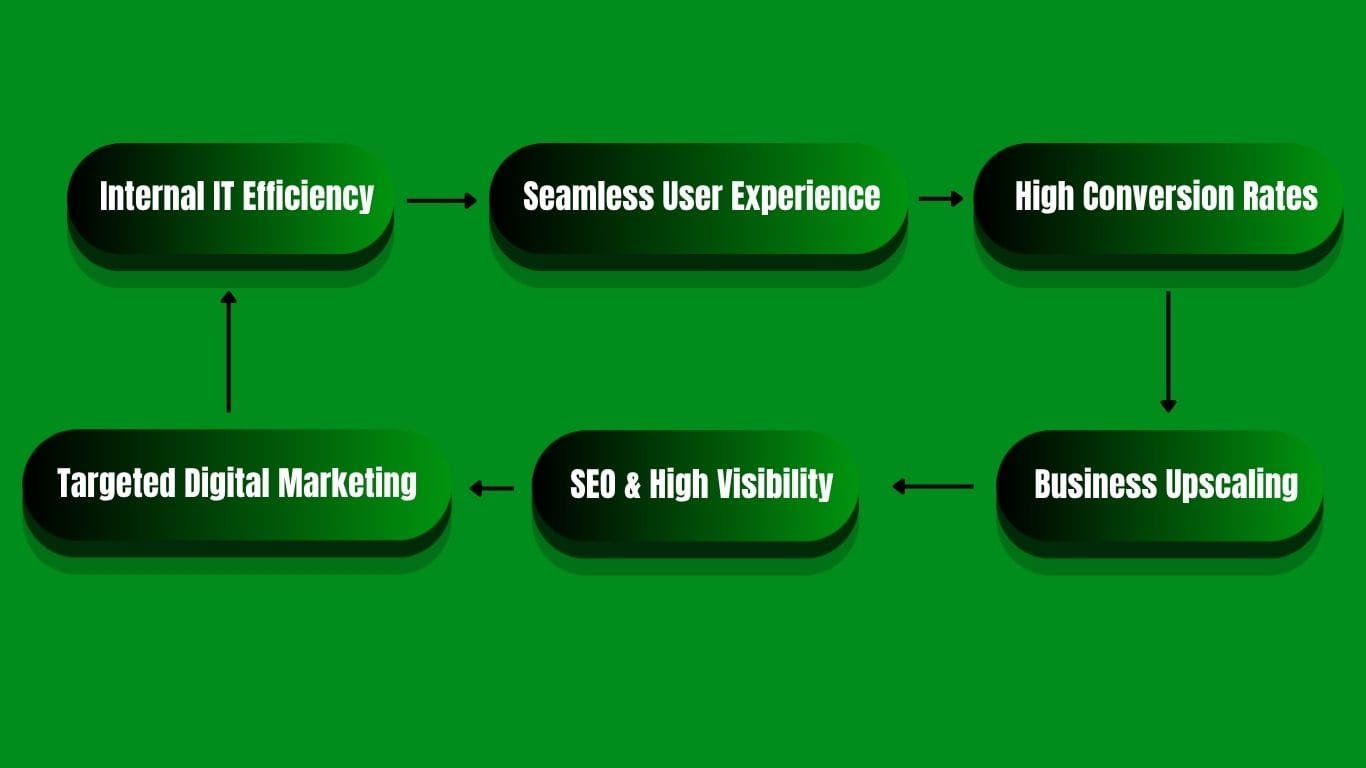
True business upscaling happens when these distinct elements—IT services, digital marketing, SEO, and UX design—are woven into a single, cohesive ecosystem.
Consider the workflow of a successfully scaled business:
-
- The Hook (Marketing & SEO): A targeted Google Ads campaign or an optimized, high-ranking blog post attracts a qualified prospect to the company website.
- The Experience (UX/UI): The prospect arrives on a website that loads instantly on their phone. The layout is clean, the copy speaks directly to their needs, and the navigation is effortless.
- The Capture (IT & CRM): The user fills out a contact form or makes a purchase. Instantly, an integrated IT system processes the payment securely, logs the customer’s data into a centralized CRM, and sends an automated, personalized onboarding email.
- The Retargeting (Data Analytics): The marketing team analyzes behavioral data from the visit, placing the customer into a custom email nurturing sequence or a social media retargeting pool to maximize their Customer Lifetime Value (LTV).
This integrated loop minimizes manual labor, eliminates data silos, cuts out operational errors, and creates a highly polished customer experience that encourages repeat business and brand advocacy.
Upscaling a business in the modern market is not a matter of choice; it is an evolution. Organizations that continue to treat IT as an isolated tech-support department and digital marketing as a luxury expense will inevitably be outpaced by agile, digital-first competitors.
By viewing technology not as an expense but as a core growth driver, you build an enterprise that is exceptionally visible on search engines, highly efficient behind the scenes, and delightfully convenient for the end-user. The future belongs to businesses that master this digital convergence. Invest in your technical foundation, refine your digital voice, prioritize your users, and watch your business scale to unprecedented heights.